

Anthropic updated its Economic Index report, which tracks how professionals are using Claude AI across various sectors. You can explore the data here. The index shows AI adoption has doubled among US employees in just two years, from 20% in 2023 to 40% in 2025. I extracted the social work education data from this comprehensive report to examine how educators fit within these broader adoption patterns.
The index analyzes anonymized usage patterns from actual Claude interactions, capturing precise behavioral data that is typically difficult to obtain in studies of technology adoption. Unlike self-reports that are prone to recall bias and social desirability effects, this dataset provides precise measurements of how professionals interact with AI in real-world contexts. Each interaction pattern, task classification, and automation-augmentation ratio represents actual observed behavior rather than estimated or retrospective accounts. This precision in measurement offers unique insight into AI adoption patterns across professions.
The findings are specific to Claude usage and may not generalize to other AI systems. (Personally, I think the usage patterns among users of ChatGPT and Gemini are not much different from those of Claude.)
Methodology and Categories
The index classifies user-AI interactions into two main categories:
Automation (⚙️): Users provide specific instructions for AI to execute tasks independently with minimal iteration. This includes:
Directive: Direct task completion with minimal back-and-forth
Feedback Loops: Automated workflows with periodic refinement
Augmentation (🤝): Collaborative human-AI interaction patterns, including:
Learning: Knowledge acquisition and conceptual clarification
Task Iteration: Multiple refinement cycles
Validation: AI feedback on user-generated work
Data Specific to Social Work Education
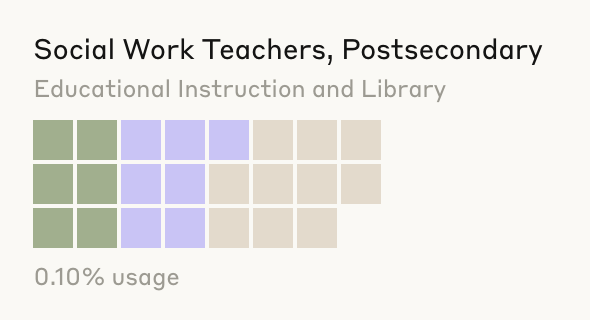
The report was based on a sample of one million Claude conversations. Social work educators represented approximately 0.10% of users in the sample. At the same time, this percentage may appear small, but it translates to a substantial user base, given the scale of Claude AI adoption. From the report, I extracted the following data from the social work education dataset, which comprises 13 professional task categories analyzed across five assistance types.
The table below presents each task category with its distribution across five AI assistance types: directive and feedback loop (automated processes ⚙️), and task iteration, validation, and learning (collaborative processes 🤝). Each row's percentages sum to 100%, with blank cells indicating assistance types not utilized for that particular task. Tasks may involve single or multiple assistance approaches depending on their complexity and requirements.
For example, task categories 1 and 2 show 100% directive assistance, indicating users employ AI purely for automated execution with no collaborative elements. In contrast, task category 7 (Plan, evaluate, and revise curricula and course content) demonstrates mixed assistance patterns: directive (43%), task iteration (50%), and learning (7%). This distribution reveals that curriculum planning combines automated processes with substantial human-AI collaboration, reflecting the complex judgment required for educational design.
Social Work Education in Context
Access Methods
The Economic Index documents two primary methods for accessing Claude AI across all user populations. The web interface enables conversational exchanges through standard internet browsers, requiring manual input for each interaction. This method achieves 50% directive automation rates across all sectors. The Application Programming Interface (API) allows direct software integration, enabling automated workflows without human intervention at each step. API users across all industries achieve 77% directive automation rates. These benchmarks provide essential context for understanding the distinctive automation patterns of social work educators, as described in subsequent sections.
Administrative Tasks Exceed Industry Benchmarks
Social work educators using Claude achieve 100% directive automation for recruitment processing and supervision documentation. This usage surpasses both general access method benchmarks (web: 50%, API: 77%). This complete automation matches the highest levels documented in corporate sectors, yet exceeds typical rates regardless of access method.
Based on the report, social work educators reserve API integration for administrative systems with standardized procedures, while maintaining conversational web-based interaction for pedagogical activities. This selective approach of maximizing automation for administrative tasks while preserving human judgment for educational functions distinguishes social work education from sectors pursuing uniform automation strategies.
Educational Content Creation Shows Selective Automation
Social work educators using Claude automate 69% of course material preparation and 64% of exam compilation. This exceeds the 39% directive rate documented across all Claude users. Yet they deliberately maintain 31-36% collaborative engagement for these same tasks, indicating strategic balance rather than maximum automation.
This pattern reflects conscious pedagogical choices. While other sectors increasingly pursue complete automation, social work educators preserve iterative refinement and validation processes within content creation, ensuring educational materials retain contextual appropriateness and professional standards.
Research Activities and Automation Trends
Social work educators maintain a 74% collaborative approach to research and publication activities, with learning-based interactions comprising 51% of all research assistance. This represents the highest learning percentage across all measured tasks and contrasts sharply with the Economic Index's documentation of declining learning interactions globally as users shift toward directive automation.
However, the 26% directive automation observed in research tasks raises ethical concerns. Social work research frequently involves human subjects, vulnerable populations, and complex contextual factors requiring professional judgment and ethical oversight. Automated research processes risk generating biases, overlooking critical contextual nuances, or compromising methodological rigor. Automating any research process, from literature review to data analysis, requires both scrutiny and transparency.
Direct Instruction and Augmentation
Classroom discussion facilitation shows 79% learning-based augmentation, while lecture preparation demonstrates 79% total collaborative augmentation (67% learning, 12% task iteration). These represent the highest collaboration rates among all measured tasks, standing in marked contrast to the Economic Index's documentation of increasing automation across professional sectors.
Social work educators preserve human-AI partnership for direct instruction, reflecting the profession's commitment to relational practice. Teaching requires adaptive judgment, cultural responsiveness, and interpersonal engagement, which are central to social work values. Yet the data reveal that 21% of both discussion facilitation and lecture preparation involves directive automation. This automation level in core pedagogical activities raises significant ethical concerns. Automated teaching components risk diminishing the relational bonds essential to social work education, potentially standardizing instruction in ways that overlook student diversity, cultural contexts, and individual learning needs. The automation of any aspect of direct student interaction challenges social work's foundational emphasis on human connection, empowerment, and individualized support.
Geographic and Economic Context
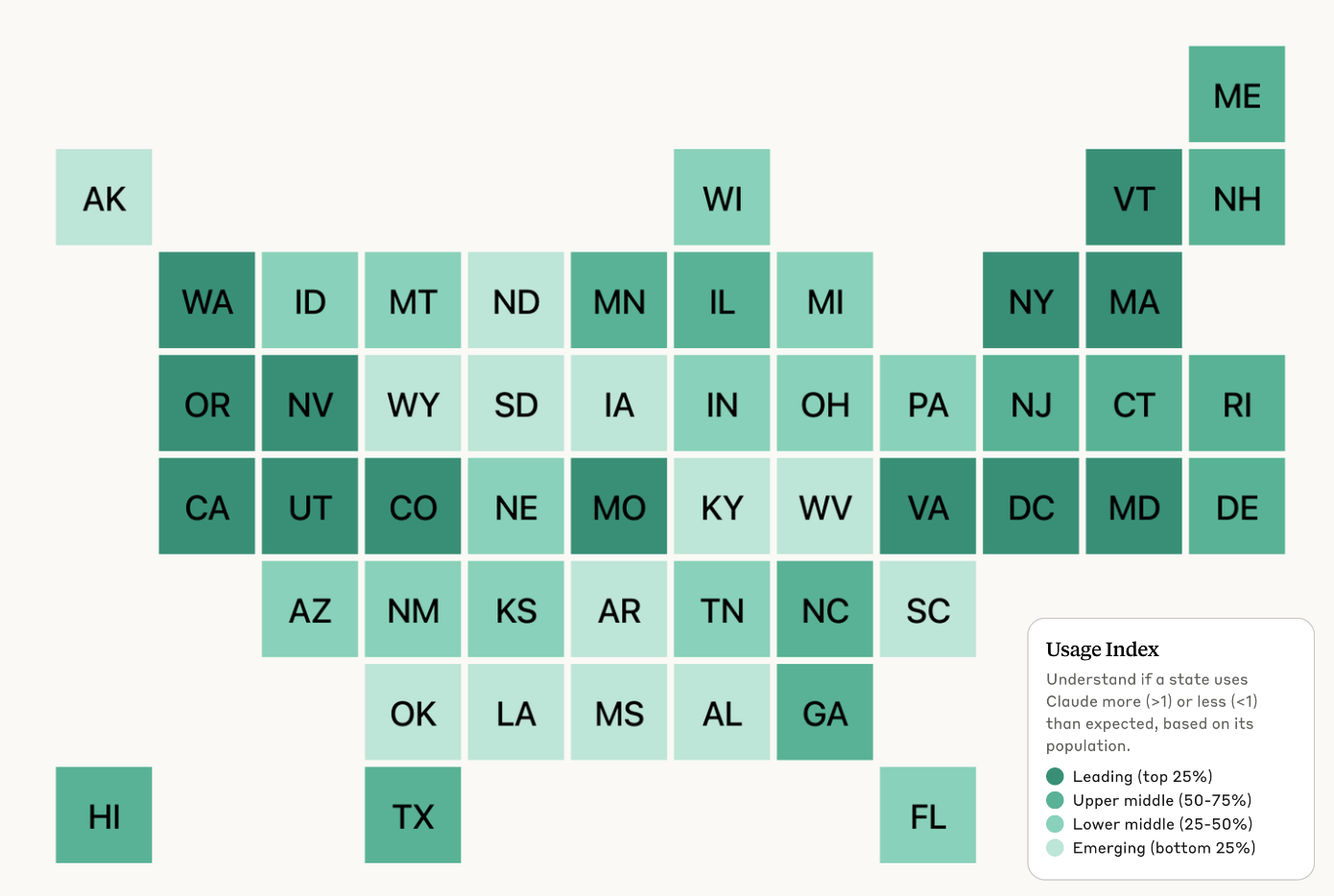
The Economic Index reveals strong geographic concentration in AI adoption across the United States. Washington, D.C., demonstrates the highest adoption rate with an Anthropic AI Usage Index of 3.82, meaning residents use Claude 3.82 times more than expected based on population alone. Utah follows closely, with a rate of 3.78, and California is next at 2.13. The report establishes an interesting pattern – that is, regions with higher adoption rates display more diverse AI applications and greater collaborative augmentation rather than simple automation. Social work education seems to have a balanced approach with AI, combining high automation for administrative tasks with collaborative patterns for teaching and research. Social work educators may be on par with AI implementation methods compared to those in technology-forward sectors, despite operating outside traditional technology domains.
Cost and Adoption Patterns
The Economic Index examines the relationship between task complexity and adoption patterns, with "cost" referring to computational demands and context requirements rather than monetary expense. Higher-cost tasks require extensive context, multiple iterations, or complex processing. The report documents explicitly that when users provide 1% more context to Claude, they receive only 0.38% more output, demonstrating reduced efficiency for context-intensive tasks. Nevertheless, users continue engaging with these computationally expensive tasks when the economic or educational value justifies the investment. The report indicates that capabilities and potential value drive adoption decisions more strongly than efficiency concerns.
For social work educators, this pattern suggests their selective automation approach reflects task-specific information needs rather than resource limitations. Social work educators may be using Claude for high-cost collaborative interactions for teaching and research activities, accepting lower efficiency in exchange for maintaining educational quality and professional standards. Conversely, their complete automation of administrative tasks demonstrates strategic resource allocation, reserving computational complexity for activities where human judgment and iterative refinement provide essential value to educational outcomes.
Conclusion
The extracted social work education data from Anthropic's Economic Index reveals distinct patterns in the adoption of AI. Educators demonstrate sophisticated task differentiation, fully automating administrative functions while maintaining collaborative approaches for core pedagogical activities. This selective integration strategy contrasts with the broader shift toward automation documented across other professions.
These findings provide an initial overview of AI usage patterns in social work education. The next step is to examine the specific social work tasks and competencies contained within the index data to understand which areas of practice show the most significant potential for AI integration and which require sustained human expertise. Such granular analysis could inform curriculum development and professional training as the field continues to navigate technological change.
Source: All data in this article were extracted from the social work education dataset within Anthropic's Economic Index (September 2025). Broader economic indicators and comparative statistics are drawn from the complete index report. Full index and underlying data available at: https://www.anthropic.com/economic-index and https://www.anthropic.com/economic-index#us-usage.
Brian - I had no idea Anthropic had data on social workers. Fascinating. I'm not sure I understand some of the data. For example, what does it mean that 100% participate in student recruitment, registration, and placement activities? Does that mean that of the conversations that social workers have using an API 100% that addressed administrative tasks were completed by AI without human editing? You wrote, "This selective approach of maximizing automation for administrative tasks while preserving human judgment for educational functions distinguishes social work education from sectors pursuing uniform automation strategies." I want to understand, but I'm confused.