

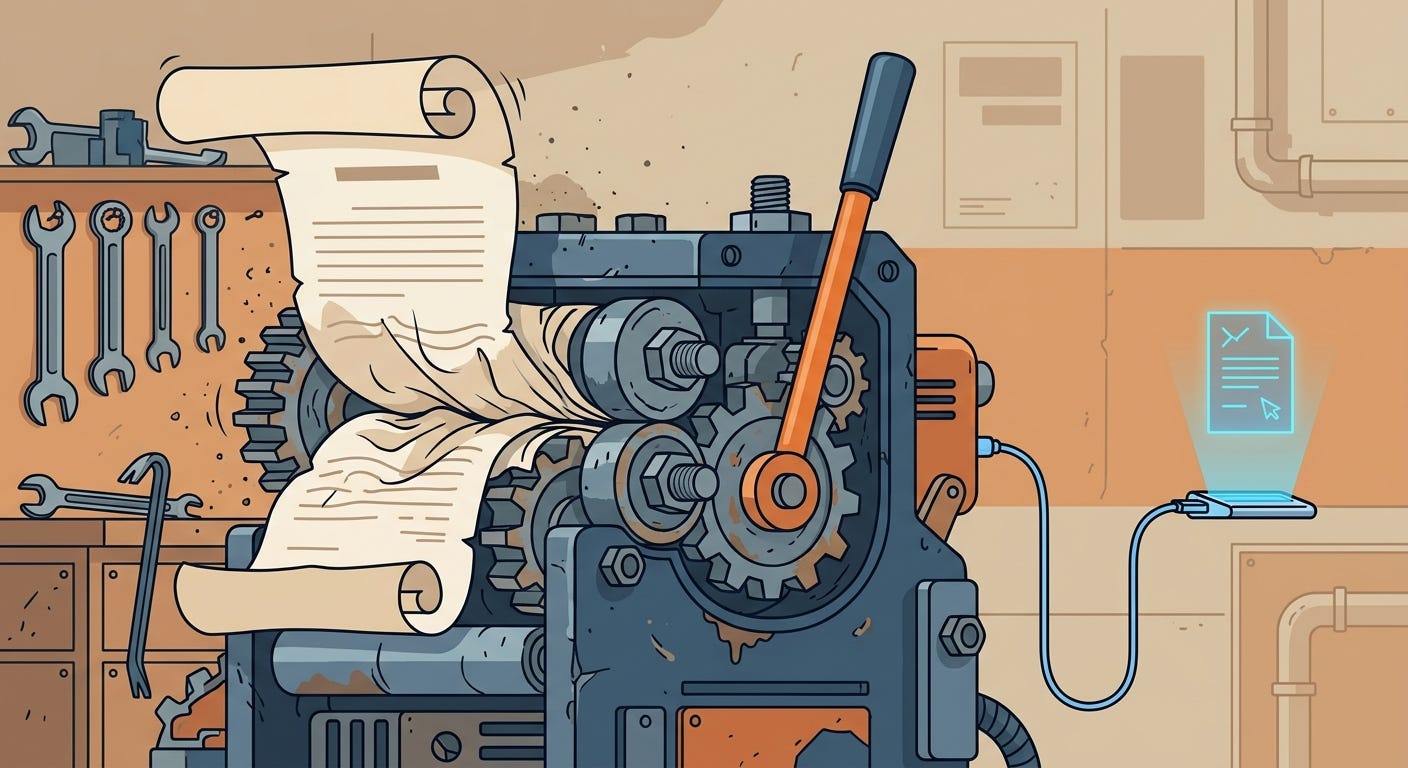
Here is a common pattern I see in my work with organizations looking to integrate AI into administrative workflows. The majority of the resources are devoted to preparing existing documents and data for machine consumption, because none of it was designed with that possibility in mind.
I call this the “retrofit tax.” This is the cost an organization incurs when it tries to bolt AI onto a workflow built exclusively for human readers or web displays. The tax is not inevitable. It is a design choice, usually made by default rather than deliberately, and it is one of the most expensive decisions organizations are making right now without realizing it.
Working example: the policy manual
Consider something that exists in nearly every organization: a policy manual. It might govern human resources procedures, academic standards, compliance requirements, or clinical protocols. These documents have been written, formatted, and distributed for human consumption long before anyone was thinking about large language models. They are optimized for someone who will read them sequentially or look up a specific section by scanning a table of contents.
Now consider what happens when someone proposes a reasonable AI application for that same content. A chatbot that answers employee questions about leave policies. A compliance checking tool that compares operational procedures against the written standards. A system that generates training materials from the policy content. A search interface that lets staff ask natural-language questions and get accurate, cited answers.
Each of these applications requires the AI system to consume policy content programmatically. And this is where the retrofit tax hits. The policy manual was published as a PDF. The PDF preserves how the document looks, but it does not reliably preserve the structure of the information. Section boundaries are visual, not semantic. Cross-references say “see Section 4.3” in prose rather than linking to a defined location. Definitions are scattered across chapters. Tables render as images. Headers that look hierarchical to a human eye may be indistinguishable from body text to a parser.
So the AI project becomes a data preparation project. You build extraction pipelines to pull text from PDFs. You write custom logic to identify where one section ends, and another begins. You design chunking strategies that attempt to keep related content together despite formatting that works against you. You build a retrieval-augmented generation system and spend weeks tuning it because the source material keeps producing inaccurate or incomplete results.
By the time the chatbot works adequately, you have spent more on document preparation than on the AI system itself. And every time the policy manual gets updated, much of that preparation work has to be repeated.
What does AI-ready actually require?
Here is what surprises most people when I walk them through this: making a document AI-ready does not require sacrificing anything about the human reading experience. It typically requires only a lightweight formatting layer on top of good content practices that most style guides already recommend.
An AI-ready policy manual at the source has a few characteristics. The content is authored in a structured plain-text format, such as Markdown, rather than directly in a formatted output like a PDF, a complex word-processing template, or an HTML web page. Heading levels are consistent and hierarchical, so a machine can reliably determine that Section 3.2.1 falls within Section 3.2, which falls within Section 3. Cross-references point to defined anchors rather than relying on page numbers or visual proximity. Definitions are collected in a consistent location or tagged inline so they can be extracted programmatically. Metadata about each section, its scope, effective date, and applicability is maintained alongside the content rather than embedded in introductory prose.
From this single structured source, a lightweight formatting layer produces whatever output the organization needs. A styled PDF for printing. A web page for the intranet. A formatted document for distribution. The human-facing outputs look exactly as they would under the traditional approach. But the source material is also immediately consumable by an AI system, with no extraction, conversion, or custom parsing required.
This is not a novel architecture. It is how modern documentation systems have worked for years. Software companies author documentation in markdown and generate websites, PDFs, and API references from the same source. The principle of separating content from presentation is well established in technical fields, even if it remains the exception rather than the rule in most other industries. Academic publishing, for instance, still largely relies on PDF as both the authoring target and the distribution format, which is one reason that mining the scholarly literature at scale remains so difficult. The point is that the tools and methods for doing this well already exist. They simply have not been applied to most administrative and organizational documents, because until recently, there was no compelling reason to do so.
The compounding cost of ignoring this
The retrofit tax is not a one-time expense but something that compounds. Each new AI use case applied to the same poorly structured source material requires its own preparation pipeline. A chatbot needs one chunking strategy. A compliance tool needs another. A training material generator needs a third. Each time the source document is revised, every downstream pipeline needs to be updated and retested.
Organizations that structure their documents for AI consumption at the source pay the design cost once. Every subsequent AI application draws from the same clean, structured material. The second use case is dramatically cheaper than the first. The tenth is nearly free.
Organizations that build strictly for human consumption and then retrofit pay the preparation cost repeatedly. Each AI application is its own project. Each revision cycle multiplies the maintenance burden. The cumulative cost over three to five years dwarfs whatever modest investment would have been required to structure the content properly at the outset.
The opportunity in every redesign
Most organizations are not going to stop what they are doing and restructure every existing document. That would be its own kind of expensive retrofit. But documents and processes get redesigned all the time. Policy manuals are revised. Handbooks are rewritten. Reporting systems are updated. Submission processes are overhauled.
Each of these redesigns is an opportunity to build in AI readiness at negligible incremental cost. The question to ask during any redesign is not “Are we building an AI tool right now?” It is “are we structuring this so that an AI tool could work with it later, if we choose to build one?” The answer almost always requires nothing more than choosing a structured source format, maintaining consistent organization, and separating content from presentation.
The organizations that build this thinking into their design processes will find that AI integration becomes routine and affordable. The organizations that continue to design exclusively for human consumption will keep paying the retrofit tax, project after project, year after year. The difference is not in the technology. It is in the decision about when to think about it.