

This is not a peer-reviewed study, but a data exercise and demonstration. Lots of selection bias here. I’m ok with that, as my point is to generate conversation rather than a line item on my CV. I scraped CVs from the (purported) top schools of social work. This produced a working sample of about 87 usable CVs. By usable, I mean that I could convert the PDFs into a machine-readable format and extract information. Using my favorite small, local LLM (Qwen 3.8 27b-mlx), I extracted PhD graduation dates, publications by year, and transition year to Associate Professor. I didn’t grab book chapters, books and presentations.
Yes, publication inflation exists
This shouldn’t be a surprise to anybody. But, rather than relying on impressions, we have some actual data. Sorry, I’m not releasing the data to avoid controversy and debates. My intentions are to simply have conversations about publication inflation in social work and how generative AI will (almost certainly) make the problem worse if we proceed, as a profession, unchecked.
I created PhD cohort years starting from 2000-04 through 2015-19, tracking them to this transition to Associate Professor. Cohorts after 2019 aren’t shown for that milestone because they haven’t had time to reach that stage yet. The growth during the assistant-professor years appears to have roughly doubled, from a median of 18 publications (2000-04) to 36 publications (2015-2019). The cohort medians track a linear trend closely: roughly one additional publication per year, consistently, since the 2000–04 cohort.
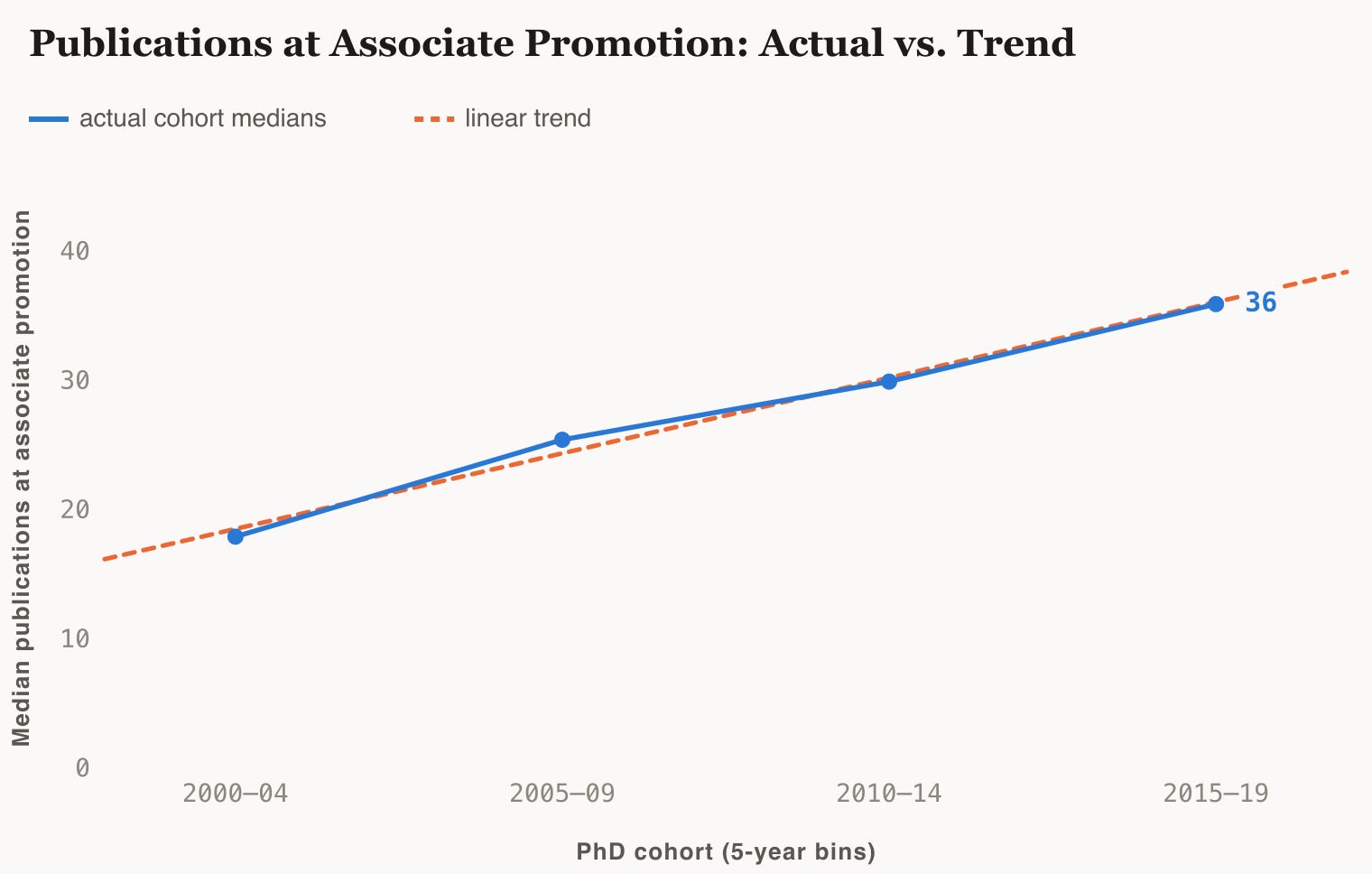
Keep in mind, the median for the 2015-2019 cohort is about 36 publications. My rough estimate for the “bar” right now is a bit higher. Of course there is a lot of variability, so I welcome debate about my numbers. I haven’t seen any other reference points. In my opinion, this is better than general impressions for discussions around high stakes milestones.
What if inflation goes unchecked with AI?
Ok, I can confidently say that generative AI removes so many friction points, allowing for articles to be churned out at unprecedented speed and volume. Perhaps only a few readers of this post remember the days of going deep into the library stacks with a copy card and spending hours holding journals and books to generate photo copies of an article. Or, walking across campus from one library to retrieve a journal or book on the shelves at another library.
Anyway, I won’t reminisce about the time spent (wasted?) in my early days of academia. Let’s just agree that generative AI and other tools makes these tasks a lot faster. If the current inflation goes unchecked and increased by generative AI, doctoral students today will be publishing at an extraordinary rate, assuming we haven’t yet debilitated our system of peer-review.
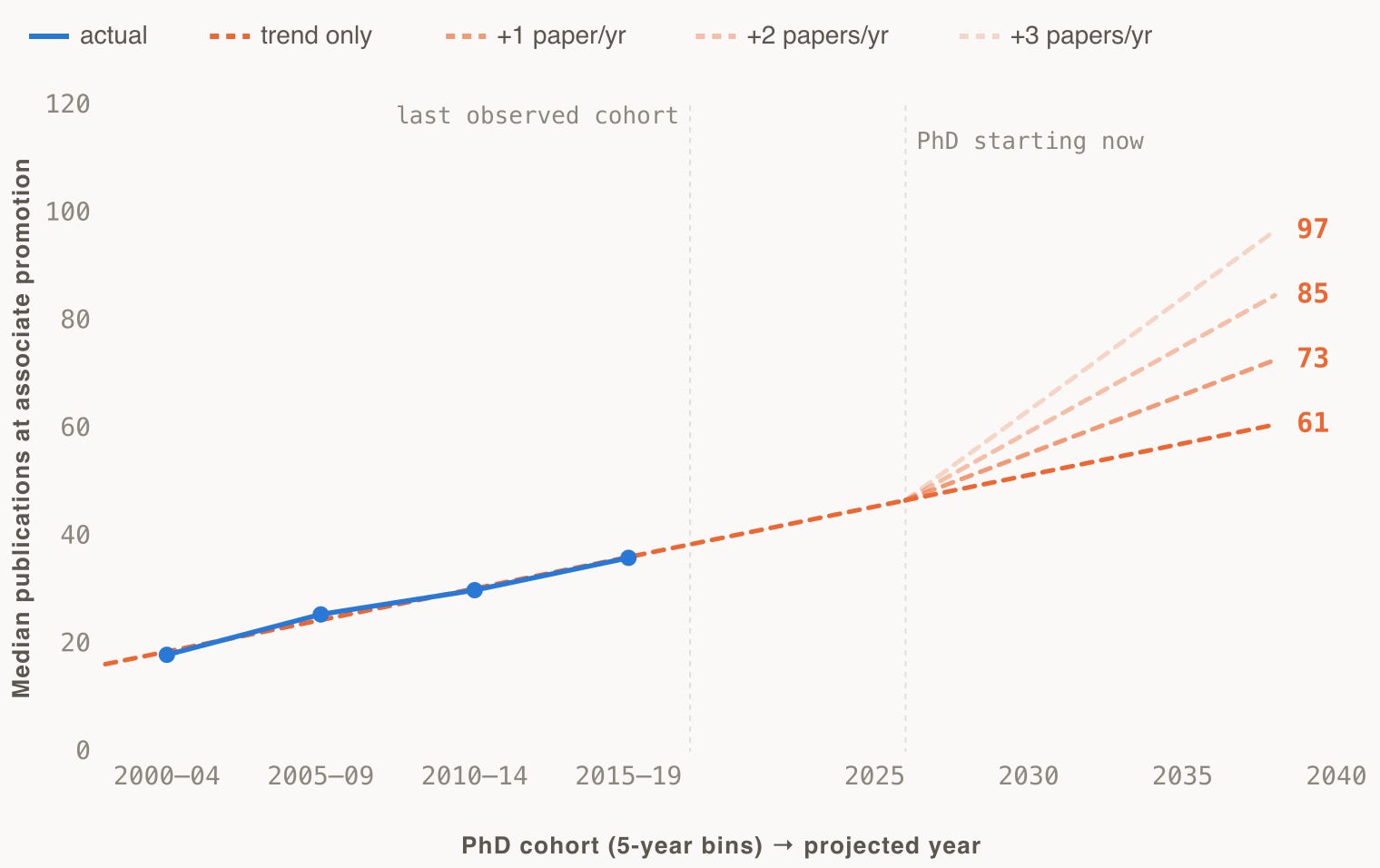
Fortunately, there is an abundance of open-access journals waiting in the wings to accept submissions (and massive open access fees) to meet this demand.